

Leading AI with Clarity and Confidence: Key Insights from Memcom's Leadership Forum
A compelling session at this year's Leadership Skills Forum revealed the current state of AI adoption in membership organisations and provided a practical roadmap for strategic implementation.
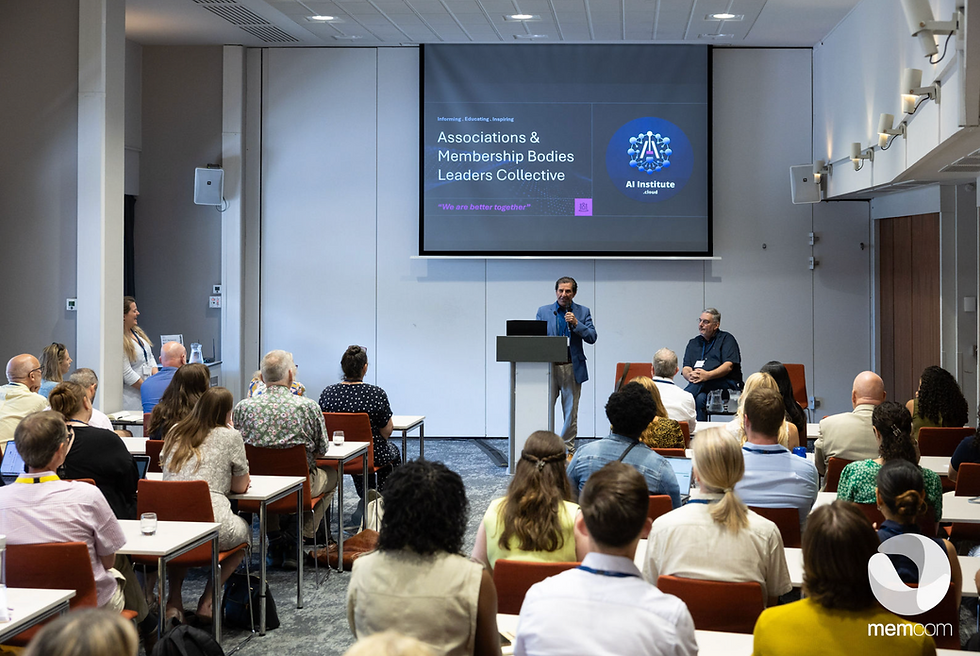
The Barbican Centre hosted over 170 C-suite executives on 10th July 2025, as Memcom's Leadership Skills Forum for membership professionals. Among the standout presentations was a thought-provoking discussion led by Niroo Rad, General Manager at AI Institute.cloud, and Alastair McCapra, CEO of the Chartered Institute of Public Relations, addressing the critical question:
"How do I lead AI with clarity and confidence?"
The Reality Check: Where We Stand Today
The session opened with sobering research findings that painted a clear picture of the current AI landscape in the membership sector. Seventy-eight percent of organisations remain in the experimental phase with AI tools, while only 15% have partially adopted AI processes. Most tellingly, zero percent report full integration, indicating that every organisation is still learning.
Even more striking was the challenge of member engagement: 85% of organisations report no change in member engagement resulting from their AI initiatives, with only 9% observing slight improvements. This reality check revealed a fundamental misalignment between internal efficiency gains and the creation of member value, as 63% use AI for meetings and 58% for marketing, yet only 18% apply it to direct member engagement.
Seven Critical Leadership Challenges
The speakers identified seven key challenges facing leaders of membership organisations today, including operational risks, governance uncertainties, cultural hesitations, and resource constraints. Building strategic knowledge emerged as the top priority, with 76% of leaders seeking strategic knowledge and confidence, 70% wanting clearer strategic guidance, and 69% needing targeted training.
As McCapra emphasised, these barriers are widespread across the sector and can be addressed collectively, reinforcing that leaders are not facing these challenges alone.

A Strategic Three-Phase Roadmap
Rather than leaving delegates with problems, the session provided a practical implementation framework based on sector research:
Phase 1: Foundation Building focuses on addressing leadership knowledge gaps through targeted education. The speakers highlighted that organisations should build on existing strengths in member communication—57% are already using AI in this area. The AI-CAE (Certified Association Executive) programme was positioned as an ideal starting point for leaders looking to build strategic confidence.
Phase 2: Pilot Implementation encourages starting with simple member inquiries for information and basic services, using specialised frameworks along with planned roadmaps while measuring impact at every stage.
Phase 3: Strategic Integration entails transitioning from viewing AI as "important but secondary" to positioning it as a core strategic element, creating sustainable roadmaps for member service delivery.
Addressing Trust Through Control
The session directly addressed governance concerns that hinder many organisations from progressing. With 36% reporting data privacy and security issues and 33% lacking trust in AI systems, the speakers suggested that chatbots could be an ideal entry point—offering controlled, rule-based implementation that allows for gradual trust-building while maintaining professional standards.
Resource Reality and Partnership Opportunities
Recognising that 61% of membership organisations have between 1 and 50 employees and that 47% face resource constraints, the presentation emphasised how AI can actually reduce operational burdens rather than increase them. Technology can level the playing field, allowing for sophisticated services that were previously unattainable due to staffing limitations.
The Collective Approach
Perhaps the most compelling aspect of the session was the introduction of the "Associations & Membership Bodies Leaders Collective"—a collaborative initiative that brings together organisations such as the CIPR, Faculty of Pharmaceutical Medicine, Makaton, and the Institute of Translation and Interpreting under the motto "We are better together."
This collective approach recognises that while individual organisations may lack resources, the sector as a whole can share knowledge, reduce implementation risks, and accelerate AI maturity through collaboration.
Looking Forward: Practical Tools for Real Leadership
The session concluded with valuable information about practical resources, including comprehensive research on AI adoption across UK associations and the AI-CAE designation programme designed specifically for leaders in the membership sector.
The key takeaway for the 120 C-suite session’s delegates was clear: successful AI leadership requires strategic knowledge, collaborative learning, and a phased approach that prioritises member value over internal efficiency. With the right framework and collective support, membership organisations can lead successfully in the evolving AI landscape.


Comments